The Virtual Terminal Subsystem
The Virtual Terminal Subsystem (vt subsystem) is part of the tty subsystem. It provides means for managing virtual terminals and handling input.
Additionally, it provides a virtual terminal tty (vt tty) driver that implements a tty device that is managed by the vt subsystem.
The VT Subsystem is implemented in
os/drivers/tty/vt.cproviding basic managementos/drivers/tty/vt_con.cproviding vt’s console interfaceos/drivers/tty/vt_insert_char.ctake the mapped lower-level input and pass it to the ttyos/drivers/tty/vt_kbd.cproviding the keyboard input handleros/drivers/tty/vt_keymap.cproviding the mapping from keycode + modifier to input character
Overview
The virtual terminal (vt) subsystem is responsible for managing virtual terminals and handling keyboard input for each terminal. See the following diagram for an overview of the interplay between the various components.
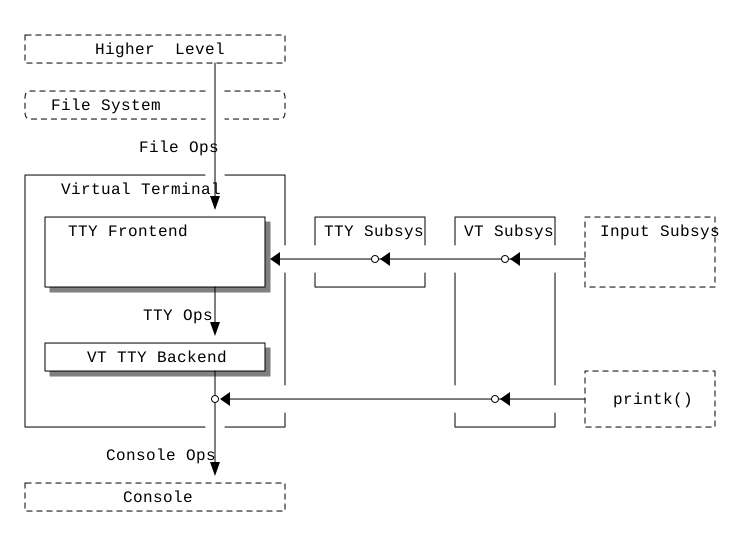
The vt subsystem provides a keyboard input handler that registers with the input
subsystem to capture and process key events.
The subsystem also exposes the console attached to the active virtual terminal
to other kernel functions, such as printk().
The keyboard input handler tracks modifier keys like Ctrl, Alt, and Shift, mapping the key events to corresponding input characters. These characters are then passed to the tty subsystem, which forwards them to the active virtual terminal or tty device.
When the input handler detects the Ctrl + Alt + Del key combination, it triggers a system reboot.
Initialization
This subsystem is initialized by calling
-
void vt_init(void)
Initialize the virtual terminal subsystem.
Initialize the vt keyboard event handler.
Allocating and Deallocating a Virtual Terminal
A new vt is allocated by calling
-
vt_t *vt_alloc(void)
Allocate and return a new vt.
The returned virtual terminal will have a new console attached to it. If this is the first virtual terminal, the initial console will be attached to it.
Note
It is currently possible to allocate a single vt, only. This function will panic otherwise.
A vt is deallocated by calling
Querying the Active Virtual Terminal
The active vt is queried by calling
Inserting a character from lower-level input
The VT subsystem receives input characters via
-
void vt_insert_char(char character)
Insert a
characterfrom lower-level input and pass it to the tty associated with the active virtual terminal.
The VT Keyboard Handler
The keyboard handler is implemented in os/drivers/tty/vt_kbd.c
Implement the keyboard-facing/-handling part of the virtual terminal driver.
Initialization
The handler is initialized by calling
-
void vt_kbd_init(void)
Register VT’s event handler to the input subsystem.
Key Event Handler Function
The input subsystem passes events to the registered handler
-
static void __vt_kbd_event(input_event_type_t type, uint16_t code, uint32_t value)
VT’s event handler.
track modifiers
handle events that VT is responsible for, e.g. Ctrl + Alt + Del
others: apply keymapping, pass to vt
- Parameters:
type – the event type, e.g., EV_KEY
code – the key code, e.g., KEY_A
value – indicates press (EV_KEY_PRESS) or release (EV_KEY_RELEASE)
Tracking Modifier Keys
Modifier keys like Ctrl, Alt, Shift are tracked using the function
-
static void __vt_track_modifiers(uint16_t code, uint32_t value)
Track the state of the key modifiers.
Track
left, right SHIFT
left, right CONTROL
left, right ALT
- Parameters:
code – the key code, e.g., KEY_A
value – indicates press (EV_KEY_PRESS) or release (EV_KEY_RELEASE)
This function in turn relies on the following helper to track an individual modifier key
-
static inline void __vt_track_modifier(uint16_t code, uint32_t value, uint16_t modifier, bool *state)
Track a modifier.
- Parameters:
code – : the key code, e.g., KEY_A
value – : indicates press (EV_KEY_PRESS) or release (EV_KEY_RELEASE)
modifier – : the key code of the modifier to be tracked, e.g., KEY_LEFTCTRL
state – : pointer to variable for tracking the state
The state of the modifier keys can be queried by calling
-
static uint8_t __vt_modifiers(void)
Convert VT’s tracked modifiers to keymap modifier mask.
Resetting Modifiers (Testing Only)
For testing purposes, a function resetting all modifiers is provided
-
void vt_reset_modifiers(void)
Reset modifiers for unit tests.
Note
Available only if the preprocessor macro
TESTINGis defined.
Keymap
The keymap for the keyboard handler is implemented in
os/drivers/tty/vt_keymap.c
Mapping a Keycode + Modifiers to a Character
A keycode along with active modifiers is mapped to a character by using the function
-
char vt_keymap_map(input_keycode_t code, uint8_t modifiers)
Map keycode + modifiers to character.
- Parameters:
code – the key code defined by the input subsystem
modifiers – a modifier mask, e.g., VT_KEYMAP_MOD_SHIFT
The modifier keys are encoded by the modifier masks
-
VT_KEYMAP_MOD_NONE
no modifiers
-
VT_KEYMAP_MOD_SHIFT
bitmask for SHIFT
-
VT_KEYMAP_MOD_CTRL
bitmask for CTRL
-
VT_KEYMAP_MOD_ALT
bitmask for CTRL
The keymap is stored in the array
-
static char __vt_keymap[KEY_NUM_ENTRIES][VT_KEYMAP_NUM_MOD]
The keymap.
This 2D array maps a key code and modifiers to a character. The first dimension is indexed by the key code – as defined in the enum input_keycode_t (drivers/input/input.h). The second dimension is indexed by the modifier mask.
The VT Console
The virtual terminal subsystem provides a console interface to be used by other
system components like, for instance, printk.
Any write to vt’s console will write to the console attached to the
currently active virtual terminal.
The console implementation of the virtual terminal subsystem can be queried by calling:
Data Types Provided by the Subsystem
The vt subsystem provides the following data types.
VT Data Structure
The data structure representing a virtual terminal device, storing the tty device and the respective console.
-
struct vt_t
Store the mapping of console and tty.